Flipbook: Apprenticeship Indenture, 1812
Documents Library
Apprenticeship Indenture, 1812
George Leather and Thomas Bartholomew
Introduction
It is not that uncommon to find surviving Indenture documents, but it was very special to come across one, dating from 1812, which referred to two individuals, later closely involved in the creation of the Aire and Calder Navigation Company’s (A&CNC) Knottingley to Goole Canal and the port and town of Goole. The Indenture found was the legal contract between experienced master land surveyor George Leather of Bradford, Yorkshire and his new apprentice land surveyor, fifteen year old Thomas Hamond Bartholomew. also of Bradford.
George Leather
In 1818, the A&CNC, published their outline plans for the Knottingley to Goole Canal based on work done by celebrated canal engineer John Rennie. The following year they felt they were ready to prepare a Bill to put before Parliament in London but for that they needed a detailed survey of the proposed route. That job was given to 33 year old civil engineer, George Leather. One can imagine that he was assisted in this work by his young protege, twenty two year old Thomas Hamond Bartholomew who had completed his apprenticeship just over a year earlier but still had much to learn.
The Bill proceeded through the Committee stages, the House of Commons and the House of Lords, finally being granted Royal Assent by King George IV, becoming an Act, so law, on 30 June, 1820. Following a widely advertised invitation to tender, on 21 June, 1821 the award of the contract for the first part of the new canal near Knottingley went to contractors Joliffe and Banks of London. They had previously worked under John Rennie on the Lancaster and Ulverston canals. Sadly, John Rennie passed away after a short illness in October that year, resulting in the appointment of George Leather as “engineer in charge” to see the project to fruition. Thus George Leather was going to be heavily involved in designing and creating the port and town of Goole which opened for business five years later.
Thomas Hamond Bartholomew
This soon to be apprentice was the son of Methodist Connexion Minister, Thomas Bartholomew of Bradford, who also features on the Indenture. It was his father who would be paying for his son’s apprenticeship and was also obliged to “provide for his said son Thomas Hamond Bartholomew sufficient and enough of all sorts of Wearing Apparel and keep the same in repair and also pay for the washing of the same”.
Thomas Hamond Bartholomew was born on 27th December, 1796 at Nottingham.
On the recommendation of George Leather, Thomas was appointed to the role of engineer for the Aire and Calder Navigation Company. His son William Hamond Bartholomew was born in 1831 and upon Thomas’s early death in 1852, the twenty one year old replaced is father as engineer to the A&CNC.
Source of the Photograph
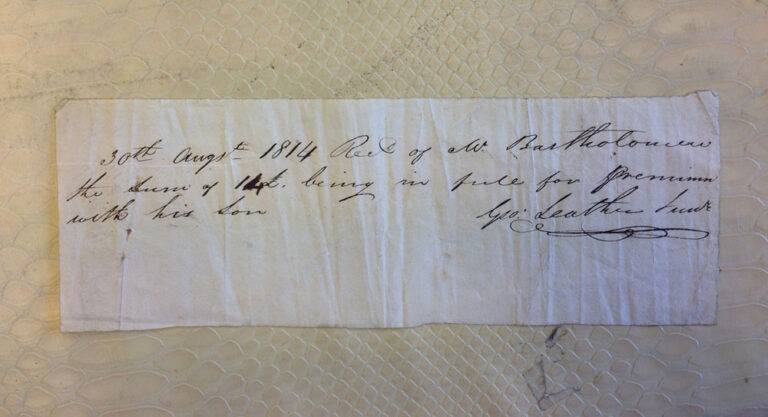
This photograph of the Indenture and an accompanying receipt was taken at the now defunct Yorkshire Waterways Museum by museum volunteer David Scrimgeour in 2018. There is no surviving record of how the Indenture had become part of the Museum’s collection.
The Indenture caught David’s eye among a collection of other documents because of the bright red wax seals. Sadly, following the YWM going into administration in 2019, the actual Indenture disappeared along with a large portion of the collection which was not moved to the East Riding Archives in Beverley.
Many thanks are due to Pippa Stainton of Goole for tidying up David’s image for presentation on this site. This photograph is the only known surviving example although others may exist.
Purpose of an Indenture for an Apprenticeship
An Indenture for an Apprenticeship in 1812 was a formal legal contract binding a young person (the apprentice) to a master for a fixed term, usually seven years, but this agreement states that Thomas would be apprenticed until he reached twenty one years of age in 1817. The purpose of this arrangement was to provide training in a trade or craft, while also obligating the master to provide care and instruction.
At the end of the term, the apprentice gained the right to work as a journeyman and later might become a master. We know that Thomas Hamond Bartholomew did complete his apprenticeship and was later recommended to the Aire and Calder Navigation Company by George Leather in 1826, becoming ???????????
Payment of fees
The indenture set out mutual obligations between apprentice and master. It often involved payment of a fee (a ‘premium’) by the apprentice’s family, or support by parish authorities for poorer children. Thomas’s father, also Thomas Bartholomew, was contracted to pay twenty nine pounds for Thomas’s apprenticeship, fifteen pounds at the time of signing the Indenture, and a further fourteen pounds on the 30th August, 1814. We know that he did so, as we also have an image of the receipt for that second payment. Twenty nine pounds in 1812 is roughly equivalent to a fee of £1,500 today.
Duties of the Apprentice
The Indenture contains statements regarding how an Apprentice was expected to behave, regarding confidentiality, honesty and loyalty to his master. It also included statements regarding what he was not allowed to do:
“fornication and adultery shall not commit, Hurt or Damage to his said Master shall not do, or Consent to be done, but to his Power shall Let it , and forthwith his said master thereof warn: Taverns or Ale-houses he shall not Haunt or Frequent, unless it be about his Masters Business there to be done; at Dice , cards, Tables, Bowls, or any other unlawful Games he shall not Play: the Goods of his said Master shall not Waste nor them Lend, or give to any Person without his Master’s Licence: Matrimony within the said Term shall not contract, nor from his Master’s Service at any time absent himself”
Publication permission for copyright images
We acknowledge that copyright images are being shown for which no explicit permission to publish has been given to this Society. Many of the digital images shown had originally been produced with the knowledge and permission of the now defunct Yorkshire Waterways Museum from original photographs deposited there for public display. Following the closure of that organisation in 2019 and the break up of their collection those original photographs have disappeared and have effectively been lost to the public.
Through an incredible stroke of good fortune digital copies of those images were donated to this Society in 2022 allowing our volunteers to finally achieve the wishes of those photographers and collectors who had made the original donations.
If you are the copyright holder and would like to contact the Society please use the form below.
Become a Supporter
Since 2023 there has been no charge for membership of the Society. You will be sent our regular email newsletter telling you what's new and coming soon. To register simply fill in the form and click Subscribe today!
Donate
Your help and donations in keeping the society, it's research and website running are much appreciated!